The Stories They Tell, The Lies We Consume: Subalternity And The Politics Of Deception In Kenyan Autobioggraphies
Synopsis
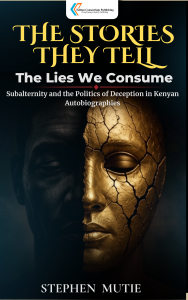
The Stories They Tell, The Lies We Consume: Subalternity and the Politics of Deception in Kenyan Autobiographies examines the intersections of nationhood, ethnicity, and identity politics, with a particular focus on their most potent expression in political autobiographies. By examining the lives and writings of leaders who “reigned but never ruled” – namely, Jaramogi Oginga Odinga, Bildad Kaggia, Joseph Murumbi, and Raila Odinga – the book argues that these concepts are closely interconnected. It reveals how these leaders used narratives that incorporated specific affirmation rituals and patterns of defiance to maintain power.
A central finding of this work is that these leaders employed a strategic form of double-speak that embodied subalternity. While they publicly championed the interests of the masses, they privately upheld those of the political elite. By positioning themselves as Kenyan subalterns, they mythologised their personas, implying that their personal political choices aligned with the best interests of the subordinate groups they claimed to represent.
This study interrogates the Kenyan political autobiography as a primary site where the nuances of “subalternity” are constructed through literary sleight of hand. By adopting the mask of the marginalized, these authors – who are historically and materially part of the Kenyan hegemony – effectively hijack the grievances of the masses. In this context, the stories they tell us are carefully curated mythologies designed to bridge the chasm between the palace and the pavement. The book offers a critical interpretive analysis of how Kenya’s political elite use life writing to construct these identities. Although the nation’s founders envisioned a unified, prosperous Kenya more than five decades ago, reality has been shaped by ethnic divisions and uneven development. This research posits that the autobiographies authored by these leaders are not objective historical records but “public transcripts” – strategic tools of deception designed to mythologize individuals and preserve entrenched personal interests, ultimately serving as “shrines of deception.”
By examining the intersection of nationhood, ethnicity, and history through the lens of strategic self-fashioning, the study analyses four seminal texts: Jaramogi Oginga Odinga’s Not Yet Uhuru, Bildad Kaggia’s The Roots of Freedom, Joseph Murumbi’s A Path Not Taken, and Raila Odinga’s The Flame of Freedom. These works reveal a recurring motif in which socialist rhetoric is used as a populist tool, framing the elite as champions of the poor to mislead the masses into believing their interests are aligned, when, in fact, such rhetoric often masks personal or class-based agendas. A central pillar of this analysis examines rhetorical performance, noting how these authors present themselves as fearless, revolutionary figures by adopting religious and messianic imagery. They often embody archetypes such as Moses or Joshua leading people to a promised land, the Messiah as the nation’s saviour, or the Prophet as a lone voice speaking truth to power.
Through a postcolonial lens that treats resistance as a strategic calculation, the work argues that claims of marginalization by these figures often mask indirection. These narratives create a flattering self-image for the elite while reinforcing existing power structures rather than dismantling them. Ultimately, this critique warns against the “danger of a single story,” suggesting that Kenyan political autobiographies are public performances of loyalty and deference intended to secure personal gain and, at times, to function as shrines of deception. By rewriting history to favour their own narratives, these elites construct a politics of deception in which the need to tell an effective story consistently outweighs the moral obligation to tell a true one.
Published
Categories
License

This work is licensed under a Creative Commons Attribution-NonCommercial-ShareAlike 4.0 International License.

